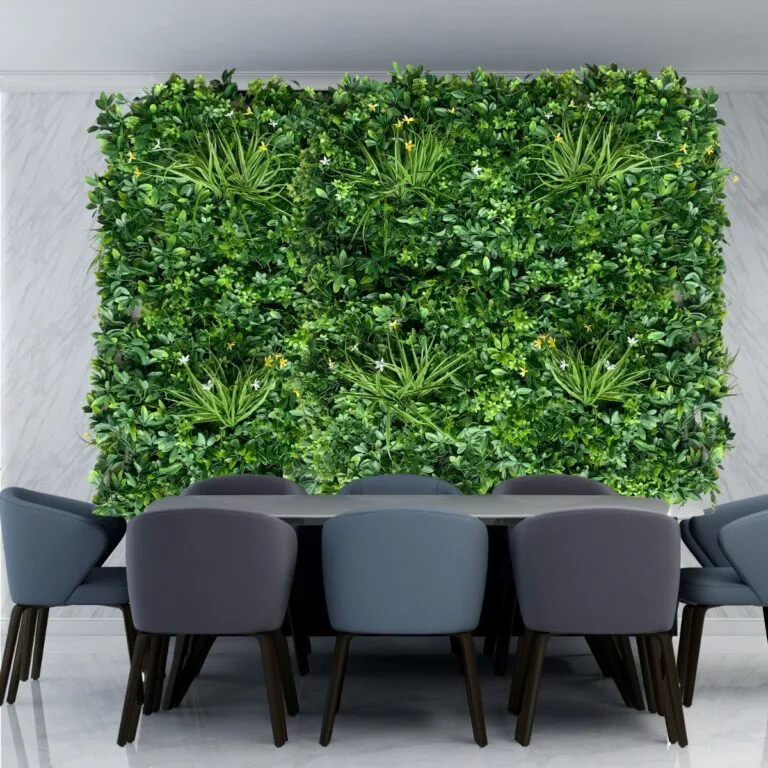

Green walls are increasingly specified as part of sustainable building strategies. The category, however, contains two different systems with different performance profiles, and the distinction matters for anyone writing a specification.
Two systems, not one
A living wall — also called a vertical garden — is a planted assembly in which vegetation grows in a vertical plane, typically supported by a hydroponic or substrate-based system with irrigation and drainage. It is a biological system and requires ongoing horticultural management.
Artificial green wall panels are a manufactured cladding element: modular panels of moulded foliage fixed to a substrate or rail. They contain no living material and require no irrigation.
Both are legitimately described as green walls. They do not deliver the same benefits, and a sustainability case built on one cannot be transferred to the other.
What living walls contribute
The environmental and wellbeing case for living walls is well documented and should be stated accurately.
Air quality. Living planting filters particulate and volatile compounds through leaf surfaces and root-zone microbiology. This is a genuine function that artificial systems do not perform.
Occupant wellbeing. Evidence suggests living planting produces measurable reductions in stress and improvements in perceived wellbeing. This is the basis for the biophilic design argument and for credits under rating systems such as WELL and LEED.
Urban heat island mitigation. Vegetation cools through transpiration and shading. At building scale this reduces surface temperature and, where a wall shields a glazed elevation, reduces solar gain.
Thermal performance. A planted assembly provides a layer of insulation and, through evapotranspiration, a cooling effect that can reduce cooling load.
These are real benefits. They are also conditional on the wall being alive and maintained.
Where artificial panels fit a sustainable brief
Artificial panels do not deliver the benefits above. Their contribution to a sustainable building strategy is different, and it is better argued honestly than overstated.
Where a living wall cannot be maintained. A living wall that fails is not a sustainable outcome — it is replacement planting, wasted water, and a disposal problem. In locations with no maintenance owner, no irrigation route, or a service access constraint, an artificial panel delivers the visual and acoustic function without the failure risk.
Acoustic performance. Dense foliage layers absorb and diffuse sound. This benefit is available from artificial panels and is frequently under-specified in commercial interiors.
Material longevity. Panel service life is determined by resin quality and UV protection rather than by horticulture. A virgin-PE panel with stabiliser compounded into the polymer has a predictable service life; a recycled-resin panel with a surface coating does not. Longevity is the environmental argument, and it depends entirely on the material specification.
Reduced operating inputs. No water, no horticultural contract, no replacement planting, no chemical treatment. Over a building’s service life this is a material reduction in operating resource, even though it is not a carbon sequestration benefit.
The practical conclusion
The sustainable building case for green walls is strongest when the system is matched to the location rather than chosen on principle. Living walls where there is light, irrigation, and a maintenance owner; artificial panels where there is not.
The trend toward green walls in sustainable building is real and is not going to reverse. What is likely to change is the precision of the specification — buyers are increasingly asking which system is being proposed and what it actually delivers, rather than accepting “green wall” as a single category. That is a healthy development for everyone specifying these systems, and it is the reason the distinction is worth stating clearly.
Related: the full system comparison is in artificial green wall or living wall; the material and UV evidence is on the materials page.