
The most common objection to artificial green walls is straightforward: they are made of plastic, and plastic has an environmental cost. That objection deserves a direct answer rather than a deflection.
The criticism, stated properly
A living wall sequesters carbon, supports pollinators, and produces measurable air-quality benefits. An artificial panel does none of these things. It is manufactured from petrochemical feedstock, it will eventually be replaced, and its end-of-life pathway is a real consideration.
We do not think this criticism can be dismissed. What can be argued is that the comparison is usually made without accounting for the operating side of a living wall’s environmental ledger — water, energy, horticultural inputs, and replacement planting.
Where the comparison changes: maintenance
The five differences below are the ones that matter in commercial specification.
- Water demand. Living walls require irrigation, and in larger installations or drier climates that demand is substantial. Artificial panels require no water at all. In regions where water is a constrained resource, this is not a minor difference.
- Pruning and fertilising. Living planting requires regular pruning to hold its form, and feeding to remain healthy. Both require horticultural knowledge and a recurring labour allocation. Artificial panels require neither.
- Pest and disease management. Living planting requires monitoring and, where necessary, chemical treatment. Artificial panels are not affected by pests or disease, which removes both the operational task and the chemical input.
- Light requirements. A living wall must be sited where there is sufficient light for photosynthesis. This constrains where it can go. Artificial panels have no such constraint and can be installed in interior zones, basements, and light-starved atria.
- Appearance over time. Living planting wilts, discolours and drops leaves, particularly where care is imperfect. Artificial panels hold their appearance — subject to the material quality question, which is covered in our article on resin selection.
What we do about it in production
We take the environmental criticism seriously at the manufacturing end, and there are three things we control.
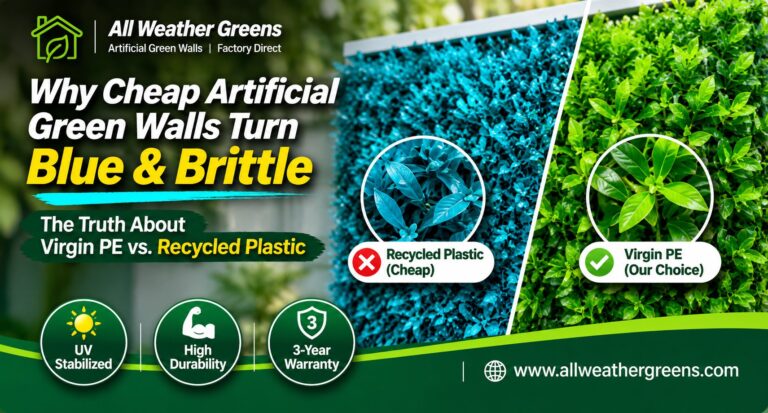
We use virgin polyethylene rather than recycled feedstock for our UV-exposed panels, because recycled resin with an unknown stabiliser history fails earlier — and a panel that has to be replaced in year two is the worse environmental outcome. We specify UV stabiliser compounded into the polymer rather than applied as a surface coating, for the same reason. And we ship DDP so that the freight and duty structure is visible to the buyer rather than hidden in a landed cost they cannot audit.
None of this makes an artificial panel environmentally equivalent to a living wall. It makes it a defensible choice where a living wall cannot be maintained — which is the honest version of the argument.
Related: what actually happens to the material outdoors is covered in why artificial green walls fade; the resin decision is explained in virgin PE versus recycled PE.