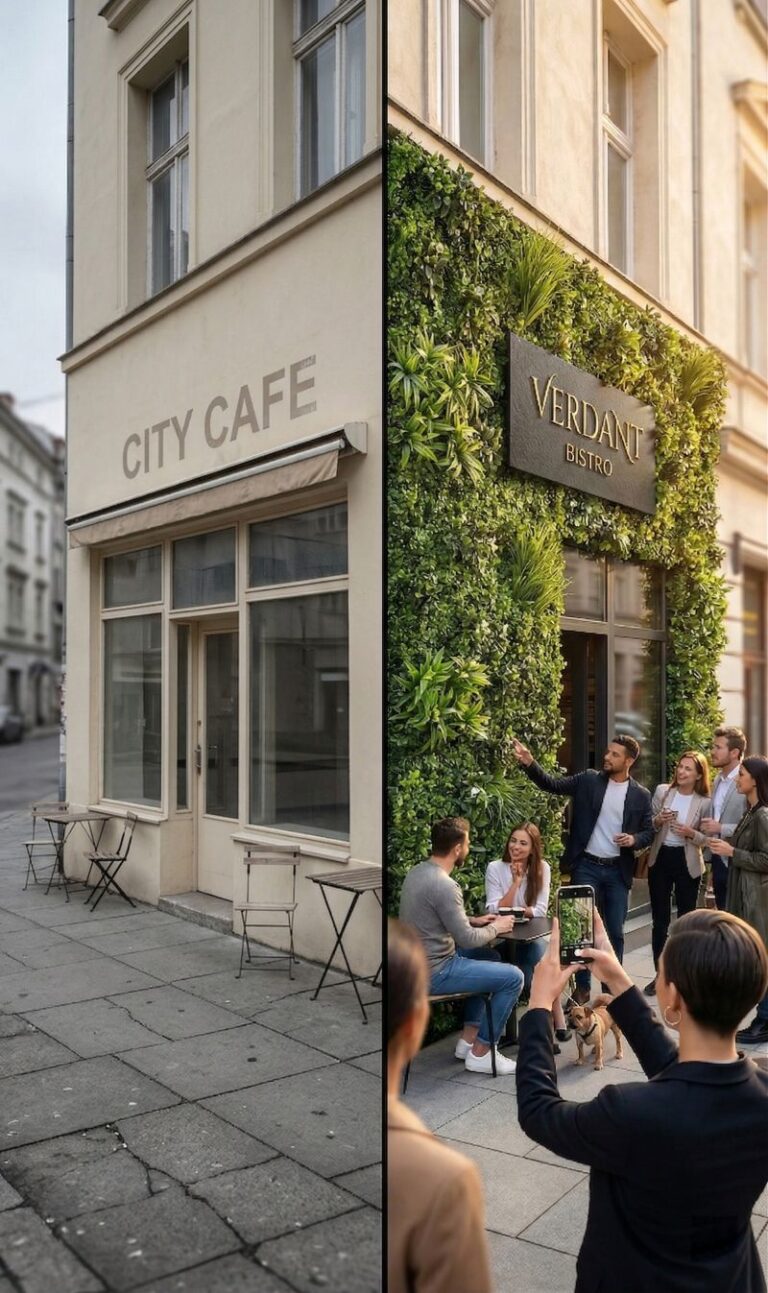

Put the two brochures side by side and both walls look stunning. Lush foliage, happy clients, dramatic before-and-after photos. On paper — and especially in photos — a living wall and an artificial one can appear to offer the same thing.
The budgets tell a different story. Before you specify artificial green wall vs living wall for a commercial project, run the numbers first: not just the installation quote, but five years of water, maintenance, replacements, and risk. This guide does exactly that, with the honesty of a manufacturer that sells one side of this comparison and still respects the other.
Upfront Cost: Installation Day
A living wall is a construction project. Behind the plants sit waterproof membranes, αποστράγγιση, irrigation plumbing, a pump and often a fertilization unit, plus the structural capacity to hold saturated growing medium. Installation requires specialist contractors, and timelines stretch accordingly. Industry-typical installed prices for hydroponic living walls run from several hundred to well over a thousand dollars per square meter, depending on system and planting design. If you want the modular panel version of this comparison, δείτε artificial vertical garden systems.
An artificial green wall is a cladding job. Panels fix to a subframe or directly to the existing wall with standard labor — the same crew that hangs signage or fits interior finishes. Material plus installation typically lands at a fraction of the living-wall figure, and a competent two-person team covers a feature wall in hours rather than weeks. See our installation guide for the full sequence.
The Ownership Years: Maintenance, Water, and Power
What a Living Wall Bills You Every Month
Plants are alive, which is precisely the point — and precisely the cost. A commercial living wall needs scheduled horticultural visits for pruning, feeding, and health checks; pump, filter, and irrigation servicing; water and electricity (often including grow lights indoors); and ongoing plant replacement, since a percentage of specimens die every year even with good care. Maintenance contracts commonly run to a meaningful percentage of the original install cost, every single year.
What an Artificial Wall Bills You
An occasional dusting or rinse. That is the entire maintenance plan. No water supply, no power, no consumables, no specialist callouts. For facility managers running dozens of sites, this difference alone settles the artificial green wall vs living wall debate before aesthetics enter the discussion.
Appearance Over Time
A living wall looks magnificent on handover day. What it looks like in year three depends entirely on the maintenance budget: light levels, water chemistry, and pruning discipline decide whether it stays lush or develops the bald patches and leggy growth that give neglected living walls away instantly.
Quality artificial panels look identical on day one and in year five. In the artificial green wall vs living wall comparison, that consistency is the artificial side’s strongest card. The one genuine threat is ultraviolet degradation in cheap products — unstabilized plastics fade and turn brittle. That failure mode is a purchasing decision, not an inherent flaw: UV-stabilized virgin PE panels, like our σειρά εξωτερικού χώρου με αντοχή στην UV, carry multi-year warranties against exactly this.
Risk and Compliance
Two risks deserve a line in every specification. The first is water: a living wall is a plumbed system mounted on a building, and pump failures or blocked drains mean leaks — sometimes inside the wall structure, where damage stays hidden until it is expensive. The second is fire: interior finish materials face strict classifications in most jurisdictions. Artificial panels should carry documented ratings such as EN 13501-1 or ASTM E84 — see our flame-retardant series for fire-retardant options — while living systems introduce their own considerations around electrical pumps in escape routes.
Where Living Walls Genuinely Win
Honesty requires this section, because the living option has real advantages. Living plants provide genuine air purification and humidity regulation, however modest the measured effect at wall scale. They deliver an authentic biophilic experience — scent, growth, seasonal change — that no polymer replicates. And they can contribute to green building credits under schemes like LEED, which matters on certified projects.
For a flagship atrium, a five-star hotel lobby, or a headquarters feature wall with a permanent maintenance budget, a living wall can be the right specification. The mistake is specifying that same system for fifty retail locations, a rental office, or a facade nobody will maintain. That, in one sentence, is the practical answer to artificial green wall vs living wall for multi-site rollouts.
Five-Year TCO: The Comparison Table
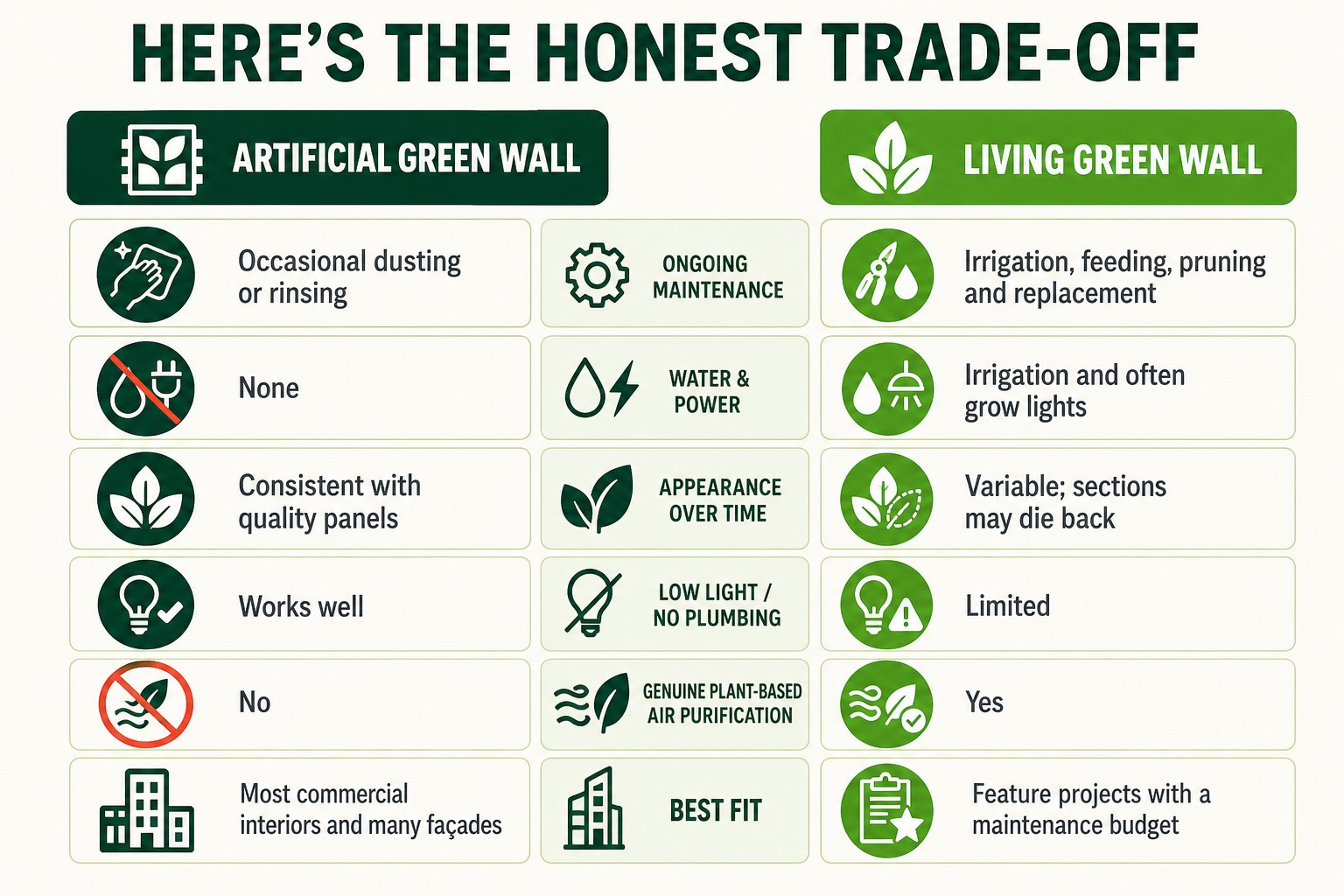
| Factor | Τεχνητός πράσινος τοίχος | Living Wall |
|---|---|---|
| Εγκατάσταση | Panels + subframe + standard labor | Waterproofing, plumbing, pumps, plants, specialist crew — typically several times higher |
| Ongoing maintenance | Occasional dusting or rinsing | Scheduled horticultural visits, κλάδεμα, feeding, system servicing |
| Water & power | None | Irrigation supply plus pump and often grow-light electricity |
| Replacements | None in normal service (UV-stabilized panels) | Ongoing plant replacement every year |
| Appearance at year 5 | Unchanged from day one | Dependent on maintenance quality; die-back is common |
| Key risks | UV fade on cheap panels (avoidable by specification) | Leaks, pump failure, pests, maintenance lapses |
| Best fit | Most commercial interiors and many facades | Feature projects with a permanent maintenance budget |
Across a typical five-year horizon, the artificial option’s total cost of ownership is dominated by day-one installation; the living wall’s TCO is dominated by everything after. For procurement teams comparing artificial green wall vs living wall bids, the living option’s year-one number is never the real number.
FAQ
Do artificial green walls purify the air?
No — and any supplier claiming otherwise should be questioned. Artificial walls deliver the visual and spatial benefits of greenery without biological functions. If measured air-quality improvement is a project requirement, that points toward a living system with a maintenance plan.
Can a living wall work without irrigation plumbing?
Only at small scale. Manual watering is viable for a few planters, not for a wall of any commercial size — inconsistent moisture is the fastest route to die-back. Commercial living walls need automated irrigation, which is where much of the cost and risk enters.
Which lasts longer outdoors, artificial or living?
Outdoors, a quality UV-stabilized artificial wall typically outlasts a living one in visual terms: living walls face frost damage, heat stress, wind burn, and seasonal die-off, while rated artificial panels hold their appearance for five to eight years with no biological variables.
Does an artificial wall look fake up close?
Cheap ones do. Dense, multi-depth panels with mixed leaf shapes and color tones are convincing at normal viewing distances — which is why we always recommend judging a physical sample rather than catalogue photos before specifying.
Which is better for leased or multi-site commercial spaces?
For teams weighing artificial green wall vs living wall across leased or multi-site spaces, artificial wins almost without exception. Panels install without plumbing alterations, remove cleanly at lease end, relocate to the next site, and need no maintenance contracts across a property portfolio.
Judge the Material Before You Run the Final Numbers
The artificial green wall vs living wall decision usually resolves itself once the five-year figures are on the table — but the quality question underneath it can only be settled in hand. Foliage density, ακρίβεια χρώματος, backing structure, and fire documentation all need physical verification.
All Weather Greens manufactures artificial green wall panels in China for importers, διαμορφωτές τοπίου, and project contractors worldwide — UV-stabilized, fire-rated, and built for long service. Ζητήστε προσφορά and benchmark the material against any living-wall quote on your desk.