
Commercial buyers should be able to compare artificial green wall panels without guessing about application fit, product documents, packing or landed cost. This guide explains the questions to ask before you shortlist a product or supplier.
On this page
- Start with the application
- Compare panel types and construction
- Compare quality beyond catalogue photos
- Match UV and fire documents to the product
- Compare landed cost on the same basis
- Use samples and order details effectively
- Pre-order buyer’s checklist
Start with the application
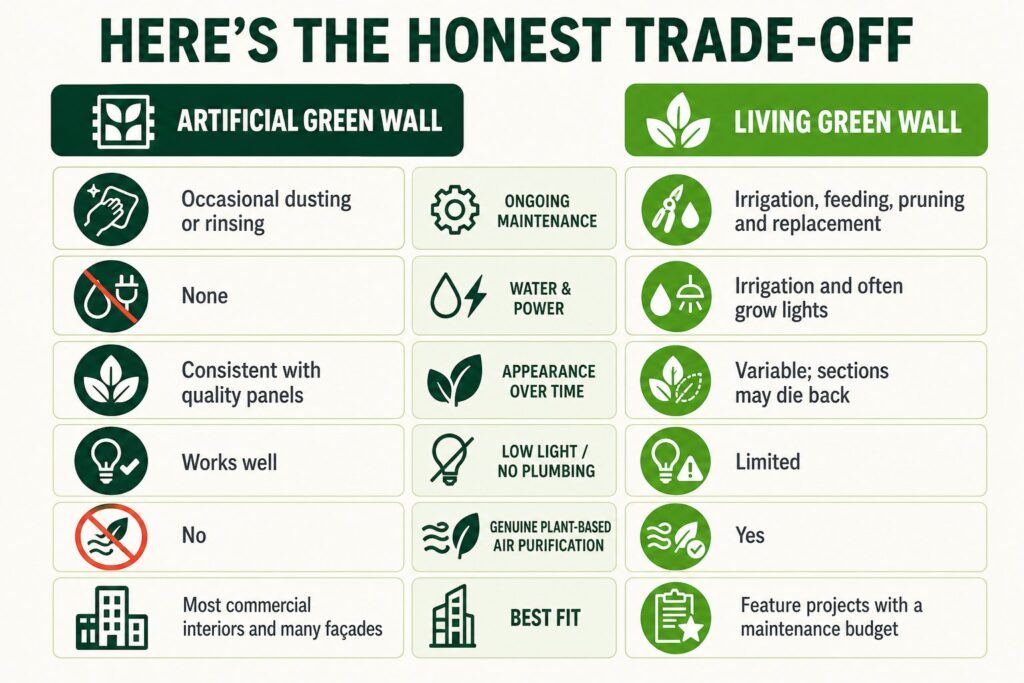
Living and artificial green walls solve different briefs. Living systems may require irrigation, drenaggio, lighting and plant care, depending on the design and site. Artificial panels do not require irrigation or routine plant care, but they can still need cleaning, fixing checks and occasional replacement of damaged components.
Before comparing products, confirm the destination country, indoor or outdoor use, sun and weather exposure, wall area, required documents and target delivery date. Those details are more useful than choosing from a catalogue image alone.
Compare panel types and construction
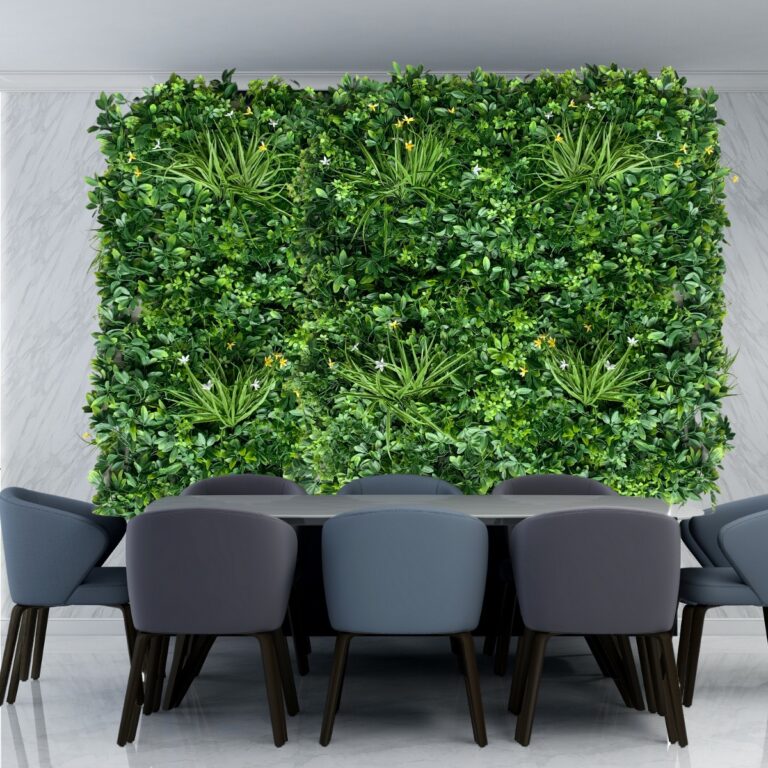
Artificial green walls are commonly assembled from modular panels. Dimensione pannello, foliage mix, densità, backing construction and attachment points vary by SKU, so confirm the specification rather than assuming every panel uses the same format.
- Mixed-foliage panels: useful where buyers want several leaf shapes, colours or textures in one design.
- Boxwood or hedge panels: provide a more uniform appearance for logo walls, screening and repeatable layouts.
- Grass or fern-dominant panels: create a lighter or finer texture and can be combined with other foliage.
- Custom or OEM builds: may allow changes to foliage mix, colour, densità, dimensioni, packaging or branding, subject to production review.
Sfoglia la artificial green wall panel range, but use a physical sample and written specification before approving a commercial order.
Compare quality beyond catalogue photos
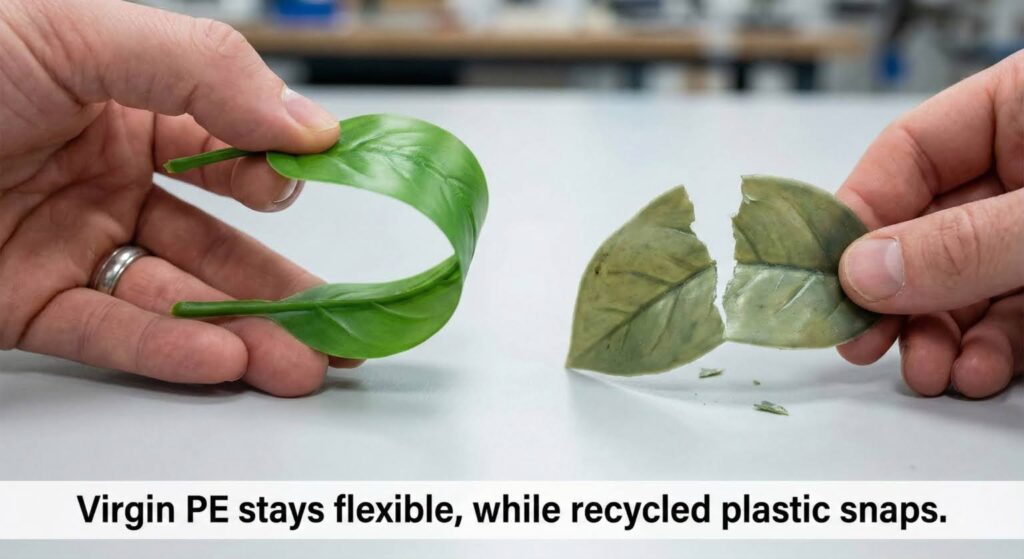
Material descriptions such as “virgin PE” or “UV stabilised” are inputs, not proof of final performance by themselves. Compare the formulation declaration, product construction, intended application and product-specific evidence together.
- Exact SKU: make sure the sample, quotation and documents identify the same product version.
- Intended application: confirm indoor, outdoor or partly exposed use and the expected climate.
- Foliage and backing: inspect density, colour variation, attachment points, edges and likely cut points.
- Panel connection: compare the grid, interlocks and fixing method for the planned substrate.
- Sample comparison: photograph different samples under the same light and from the same distance.
Match UV and fire documents to the product
UV and fire-performance requirements vary by application, product and destination. Per SKU selezionati, product-specific documents may be available, but availability should be confirmed before order.
- Check the exact product or SKU named in the document.
- Check the test method, classification and tested specimen.
- Confirm whether the document covers the complete supplied assembly or only one component.
- Review the report date, laboratory and stated limitations.
- Ask the responsible project professional to confirm the local requirement.
A classification from one product should not automatically be copied to another SKU or treated as suitable for every country or project. Review the selected fire-performance options E selected outdoor UV options, then request the applicable document for the product being considered.
Compare landed cost on the same basis
Unit price alone does not show the full cost of a project. Compare quotations using the same panel coverage, specification, packing quantity, destination, currency, date and Incoterm.
Panels needed = wall area ÷ confirmed panel coverage
Estimated landed cost = product cost + freight + applicable duties, taxes and local charges
Estimated cost per m² = estimated landed cost ÷ wall area
FOB, CIF and DDP quotations allocate costs and responsibilities differently. DDP may be available for some destinations and orders, but availability, importer responsibilities, taxes and delivery scope should be confirmed in the formal quotation with the supplier and, where needed, a customs broker.
Use samples and order details effectively
- Sample: inspect the front, retro, bordi, attachment points, colour and SKU label.
- Moq: confirm the minimum for the exact series, packaging and customisation required.
- Lead time: confirm production and dispatch timing for the specific order rather than relying on a general estimate.
- Spedizione: compare available sea, air or express options for the destination and order size.
- Documents: confirm which product-specific files will be supplied before the order is approved.
Campioni gratuiti disponibili: fino a 3 pz per richiesta B2B qualificata. Spedizione internazionale a carico dell'acquirente. Exact sample size, disponibilità, courier route and timing are confirmed before dispatch. For MOQ, shipping terms and documentation questions, vedi la trade buyer FAQ.
Pre-order buyer’s checklist
| Check | What to confirm |
|---|---|
| Applicazione | Interni, outdoor or partly exposed; destination and climate |
| Prodotto | Exact SKU, panel size, coverage and construction |
| Sample | Same product version as the quotation |
| UV or fire documents | Prodotto, metodo di prova, specimen, date, laboratory and limitations |
| Imballaggio | Carton quantity, dimensions, labels and spare allowance |
| MOQ and customisation | Confirmed for the selected series |
| Lead time | Production and dispatch timing for the order |
| Incoterm | Responsibilities, destination and included charges |
| Landed cost | Compared on the same specification and destination basis |
Next step
Send your destination country, applicazione, wall area or estimated quantity, required UV or fire documentation and target delivery date. We will help identify the next useful sample, specifica o documento da esaminare.