
Sie können das Menü perfektionieren, das Personal schulen, and nail the interior design — and still watch potential customers walk straight past your front door without a glance. For brick-and-mortar venues, the first transaction happens on the sidewalk: people see you long before they search for you.
That is why restaurant groups, retail chains, and hospitality designers increasingly treat the exterior wall as revenue infrastructure rather than decoration. And more and more of them are doing it with artificial green walls for restaurants, Cafés, and storefronts — installations that deliver a striking living-wall look without irrigation lines, maintenance contracts, or seasonal die-off. For storefront, checkout-area and roll-out specifications, see our dedicated page on artificial green walls for retail.
Why Your Exterior Is Your First Sales Pitch
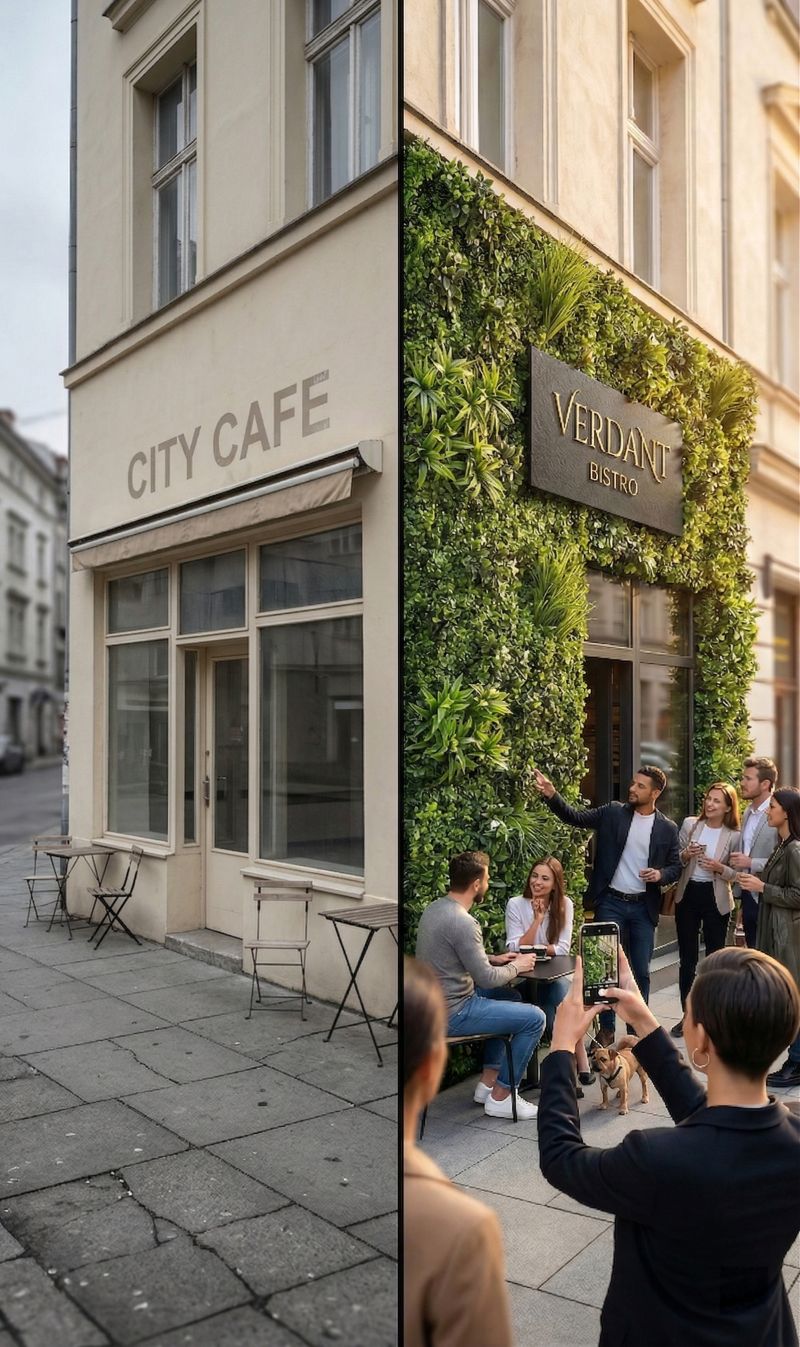
Pedestrians decide whether a venue is worth a second look in a fraction of a second. A blank concrete render, a tired signboard, or a faded awning communicates nothing. A textured, deeply green facade communicates freshness, care, and quality before a single word is read.
For hospitality and retail operators, this is not an aesthetic luxury. It is the top of the funnel. Every marketing dollar spent on social ads, delivery platforms, and influencer campaigns works harder when the physical storefront already stops people in their tracks.
The Green Wall Effect: Three Ways a Facade Converts Foot Traffic
There is a reason the most-photographed cafés in London, Lisbon, and Sydney share one feature: a dramatic green backdrop. When a high-quality artificial plant wall wraps an exterior or frames an al fresco dining area, three mechanisms start working automatically.
1. The Photo Trigger
People photograph a striking green wall, post it, and tag the location. Every tagged post is free, geolocated advertising shown to hundreds of local followers who have never heard of the brand. Paid reach ends when the budget ends; user-generated content keeps compounding. For artificial green walls for restaurants on busy pedestrian streets, this organic exposure alone often outperforms the venue’s paid social budget.
2. The Slow-Down Effect
A visually rich, layered facade physically slows pedestrians down. That two-second pause is the difference between “that place I walked past” Und “that cool green spot I keep meaning to try.” In dense urban streets, winning the pause is winning the visit.
3. The Premium Signal
Customers unconsciously read the exterior as a proxy for what happens inside. A premium facade implies a premium kitchen, a premium cup of coffee, a premium fitting room — and that assumption translates directly into willingness to pay and to return. Research into biophilem Design consistently links visible greenery with longer dwell times and higher perceived value.
Run the Numbers: A Facade Is a Media Buy That Never Stops
Consider a typical urban restaurant on a mid-traffic street with 500 to 800 pedestrians passing per hour. If a compelling exterior lifts the stop-and-look rate by just 3 percent, that is 15 to 24 additional potential customers noticing the venue every single hour it is open.
Now compare the cost structure. Digital ads bill you every month for the same eyeballs. A premium artificial green wall is a one-time capital investment with essentially zero operating cost — and the visual impact in year five is identical to day one, provided the panels are properly specified. For operators weighing artificial green walls for restaurants against a recurring ad budget, the payback period is usually measured in months, not years.
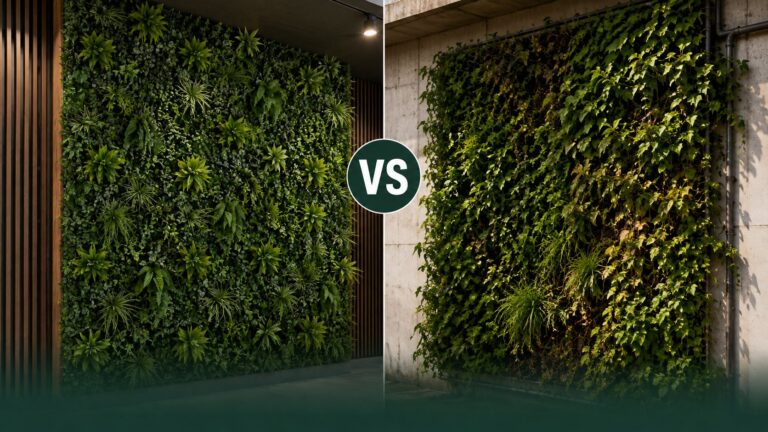
Why Operators Choose Artificial Over Living Walls Outdoors
Living walls are beautiful in brochures and brutal in budgets. Außenbereich, they demand permanent irrigation plumbing, monthly horticultural maintenance, winter replacement planting in cold climates, and constant vigilance against leaks that can damage the structure behind the panels.
A commercial-grade artificial green wall removes that entire cost line: kein Wasser, no pruning, no pest control, no dead patches in August. For multi-site operators, the economics are even clearer — the same facade spec can be rolled out across fifty locations with identical results and no dependency on local climate or maintenance contractors. Buyers sourcing at scale can review specs on our Künstliche grüne Wand im Großhandel Seite.
Buying Artificial Green Walls for Restaurants: Four Specs to Check
Not every panel survives an exterior environment. Before signing a purchase order, procurement teams and project contractors should verify four things.
UV Resistance Is Non-Negotiable
Sunlight is the number one killer of cheap artificial greenery. Panels made from recycled or unstabilized plastics fade, shift blue, and turn brittle within a season or two — and a half-dead plastic hedge is worse than no hedge at all. Specify virgin PE foliage with UV stabilizers compounded into the material, not sprayed on afterward, and ask for the warranty terms in writing. It is the most common failure point we see in artificial green walls for restaurants with south- or west-facing frontages. Unser outdoor UV-resistant artificial green walls are engineered for exactly this exposure.
Fire Ratings for Code Compliance
Restaurants and retail units face strict interior finish codes, and many exterior zones near entrances, kitchens, or egress routes fall under the same scrutiny. Insist on tested fire performance — EN 13501-1 classification for European and Middle Eastern projects, ASTM E84 for North America — and request the actual test reports, not marketing claims. See our flammhemmende künstliche Pflanzenwände for compliant options.
Wind Load and Mounting
An exterior facade is a sail. Panels should be mechanically fixed to a rigid subframe rated for local wind loads, with stainless or galvanized hardware in coastal and high-humidity markets. For large elevations, have the mounting design signed off by the project’s structural engineer.
Density and Realism at Viewing Distance
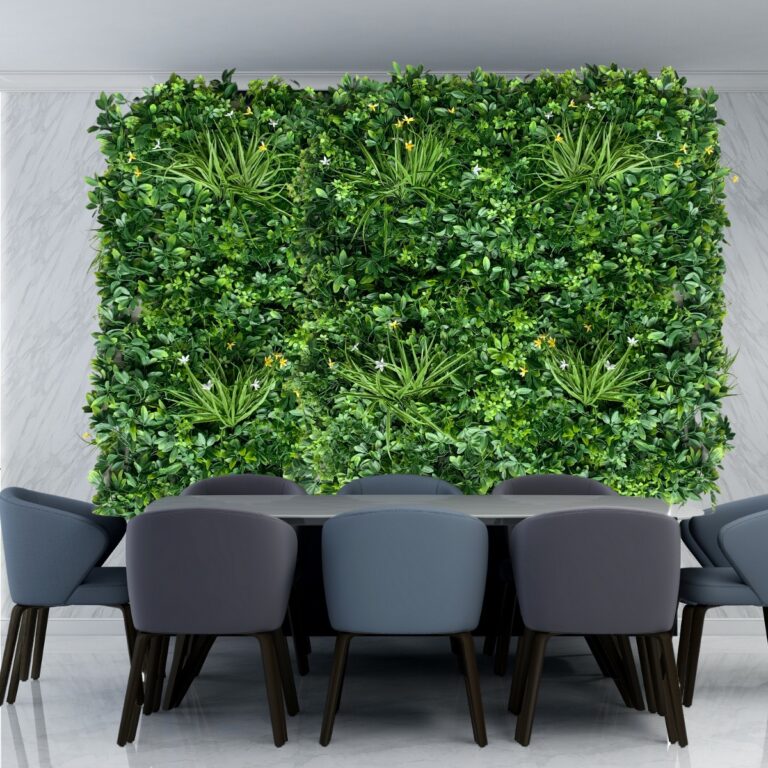
Street-level installations are judged from two to ten meters, up close. Specify dense, multi-depth foliage with mixed leaf shapes and tones; sparse flat mats read as plastic from across the road. If the venue needs brand colors, logo integration, or seasonal décor swap-outs, a custom artificial green wall build solves it at the factory rather than on a scaffold.
FAQ
How long does an outdoor artificial green wall last?
Quality UV-stabilized virgin PE panels typically deliver five to eight years of outdoor service, depending on sun exposure and climate. Reputable manufacturers back this with multi-year UV warranties.
Will the panels fade in direct sunlight?
Artificial green walls for restaurants in full-sun locations should always be specified with compounded UV protection. Non-stabilized panels will fade, often within months. UV-stabilized panels resist fading and embrittlement for years. Always confirm whether UV protection is compounded into the raw material and request accelerated-weathering test data.
Are artificial green walls allowed under restaurant fire codes?
Yes — artificial green walls for restaurants and hospitality venues are permitted under most fire codes when the product carries the appropriate fire classification for the jurisdiction — commonly EN 13501-1 in Europe and the Gulf, or ASTM E84 in the US. Requirements differ for interior and exterior zones, so share the test reports with your local authority or fit-out contractor before installation.
What does a commercial exterior green wall cost?
Pricing depends on panel density, Brandschutzklasse, customization, and order volume. Buying factory-direct in project quantities lowers unit costs significantly, and the absence of irrigation and maintenance keeps lifetime cost far below a comparable living wall. Request a project quotation for exact figures.
Can we integrate logos, lighting, or seasonal decorations?
Ja. Custom fabrication can incorporate brand colors, Beschilderung, planter boxes, and interchangeable seasonal elements during production, which is faster and cleaner than modifying panels on site.
See the Quality Before You Specify It
Photos help, but procurement decisions on facade materials should be made with the product in hand — foliage density, Farbgenauigkeit, backing structure, and fire certification all need a physical check.
Whether you are sourcing artificial green walls for restaurants, retail rollouts, or hospitality venues, the four checks above will keep the project on budget and on code. All Weather Greens is an artificial green wall manufacturer in China, exporting to importers, Landschaftsgestalter, and project contractors across Europe, the Middle East, und Südostasien. Angebot anfordern and evaluate the material, UV-Schutz, and build quality against your project specification before you commit.