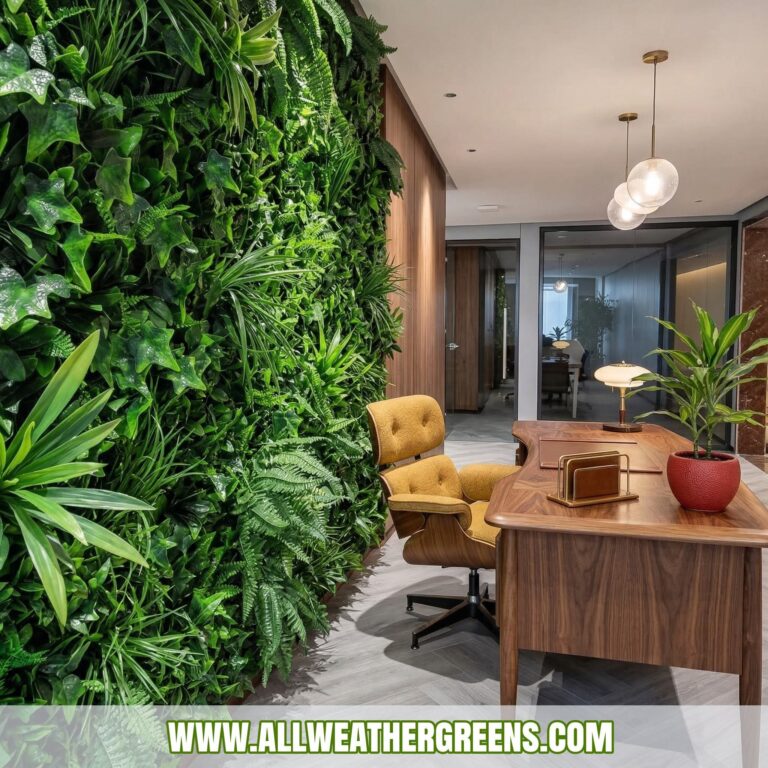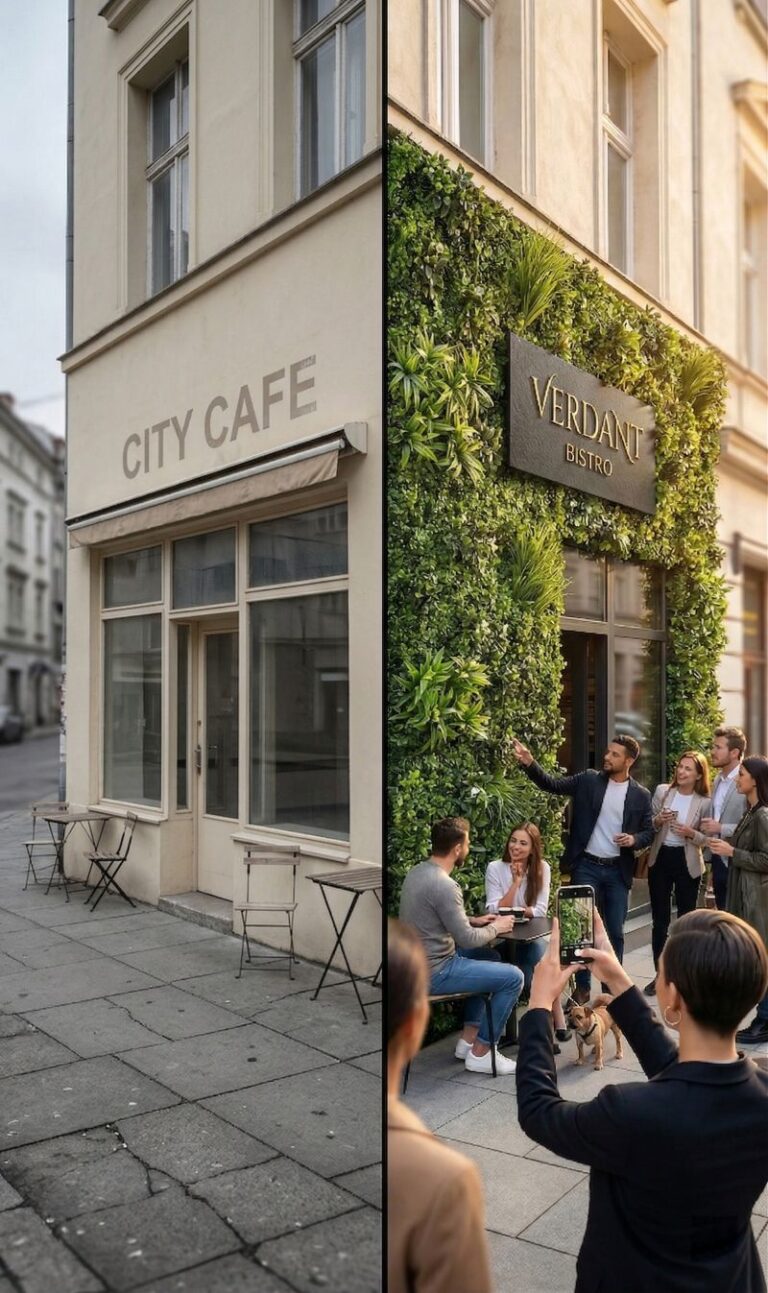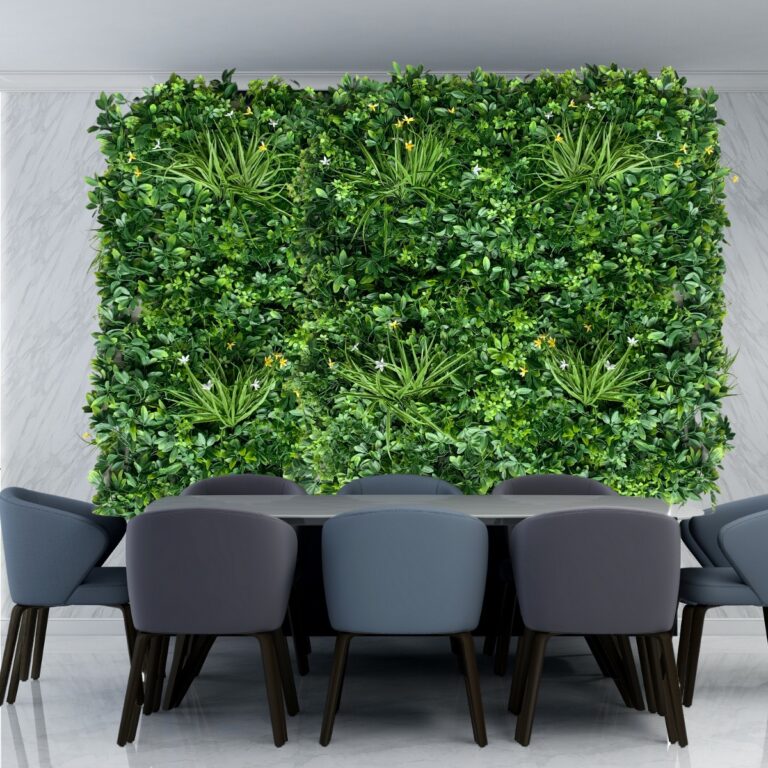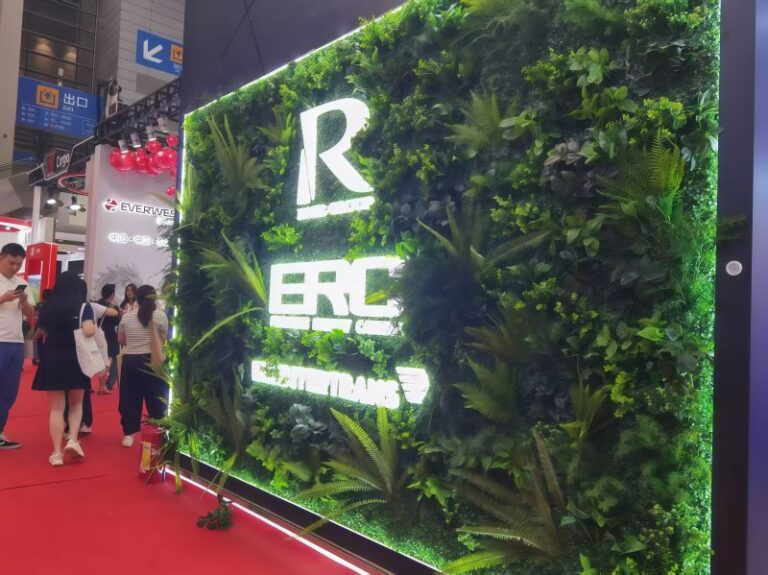

Mettez les deux brochures côte à côte et les deux murs sont superbes. Feuillage luxuriant, clients satisfaits, photos avant-après spectaculaires. Sur le papier — et surtout en photos — un mur végétal vivant et un mur végétal artificiel peuvent sembler offrir la même chose.
Les budgets racontent une autre histoire. Avant de choisir entre mur végétal artificiel et mur végétal vivant pour un projet commercial, commencez par faire les calculs: pas seulement le devis d'installation, mais cinq ans d'eau, d'entretien, de remplacements, et de risques. Ce guide fait exactement cela, avec l'honnêteté d'un fabricant qui vend un côté de cette comparaison et respecte malgré tout l'autre.
Coût initial: Jour de l'installation
Un mur végétal vivant est un projet de construction. Derrière les plantes se trouvent des membranes imperméables, drainage, plomberie d'irrigation, une pompe et souvent une unité de fertilisation, ainsi que la capacité structurelle de supporter un substrat de culture saturé. L'installation nécessite des entrepreneurs spécialisés, et les délais s'allongent en conséquence. Les prix installés typiques du secteur pour les murs végétaux hydroponiques vont de plusieurs centaines à bien plus de mille dollars par mètre carré, selon le système et la conception de la plantation. Si vous souhaitez la version en panneaux modulaires de cette comparaison, voir systèmes de jardins verticaux artificiels.
Un mur végétal artificiel est un travail de bardage. Les panneaux se fixent sur une ossature secondaire ou directement sur le mur existant avec une main-d'œuvre standard — la même équipe qui pose la signalétique ou réalise les finitions intérieures. Le matériau plus l'installation revient généralement à une fraction du montant d'un mur végétal vivant, and a competent two-person team covers a feature wall in hours rather than weeks. See our installation guide for the full sequence.
The Ownership Years: Maintenance, Water, and Power
What a Living Wall Bills You Every Month
Plants are alive, which is precisely the point — and precisely the cost. A commercial living wall needs scheduled horticultural visits for pruning, feeding, and health checks; pump, filter, and irrigation servicing; water and electricity (often including grow lights indoors); and ongoing plant replacement, since a percentage of specimens die every year even with good care. Maintenance contracts commonly run to a meaningful percentage of the original install cost, every single year.
What an Artificial Wall Bills You
An occasional dusting or rinse. That is the entire maintenance plan. No water supply, no power, no consumables, no specialist callouts. For facility managers running dozens of sites, this difference alone settles the artificial green wall vs living wall debate before aesthetics enter the discussion.
Appearance Over Time
A living wall looks magnificent on handover day. What it looks like in year three depends entirely on the maintenance budget: light levels, water chemistry, and pruning discipline decide whether it stays lush or develops the bald patches and leggy growth that give neglected living walls away instantly.
Quality artificial panels look identical on day one and in year five. In the artificial green wall vs living wall comparison, that consistency is the artificial side’s strongest card. La seule véritable menace est la dégradation par les ultraviolets dans les produits bon marché — les plastiques non stabilisés se décolorent et deviennent cassants. Ce mode de défaillance relève d'une décision d'achat, et non d'un défaut inhérent: Panneaux en PE vierge stabilisés UV, comme les nôtres gamme extérieure résistante aux UV, bénéficient de garanties de plusieurs années contre exactement ce risque.
Risques et conformité
Deux risques méritent une ligne dans chaque cahier des charges. Le premier est l'eau: un mur végétal est un système raccordé à la plomberie, monté sur un bâtiment, et une panne de pompe ou un drain bouché provoque des fuites — parfois à l'intérieur de la structure du mur, où les dégâts restent invisibles jusqu'à ce qu'ils coûtent cher. Le second est le feu: les matériaux de finition intérieure sont soumis à des classifications strictes dans la plupart des juridictions. Les panneaux artificiels doivent présenter des classements documentés tels que EN 13501-1 ou ASTM E84 — voir notre gamme ignifuge for fire-retardant options — while living systems introduce their own considerations around electrical pumps in escape routes.
Là où les murs végétaux vivants l'emportent véritablement
L'honnêteté exige cette section, car l'option vivante présente de réels avantages. Les plantes vivantes offrent une véritable purification de l'air et une régulation de l'humidité, quelle que soit la modestie de l'effet mesuré à l'échelle du mur. Elles procurent une expérience biophilique authentique — parfum, croissance, changement saisonnier — qu'aucun polymère ne reproduit. Et elles peuvent contribuer aux crédits de construction durable dans le cadre de référentiels comme LEED, ce qui compte sur les projets certifiés.
Pour un atrium emblématique, un hall d'hôtel cinq étoiles, ou un mur signature de siège social avec un budget de maintenance permanent, un mur végétal vivant peut être la spécification appropriée. L'erreur est de spécifier ce même système pour cinquante points de vente, un bureau en location, or a facade nobody will maintain. That, in one sentence, is the practical answer to artificial green wall vs living wall for multi-site rollouts.
Five-Year TCO: The Comparison Table
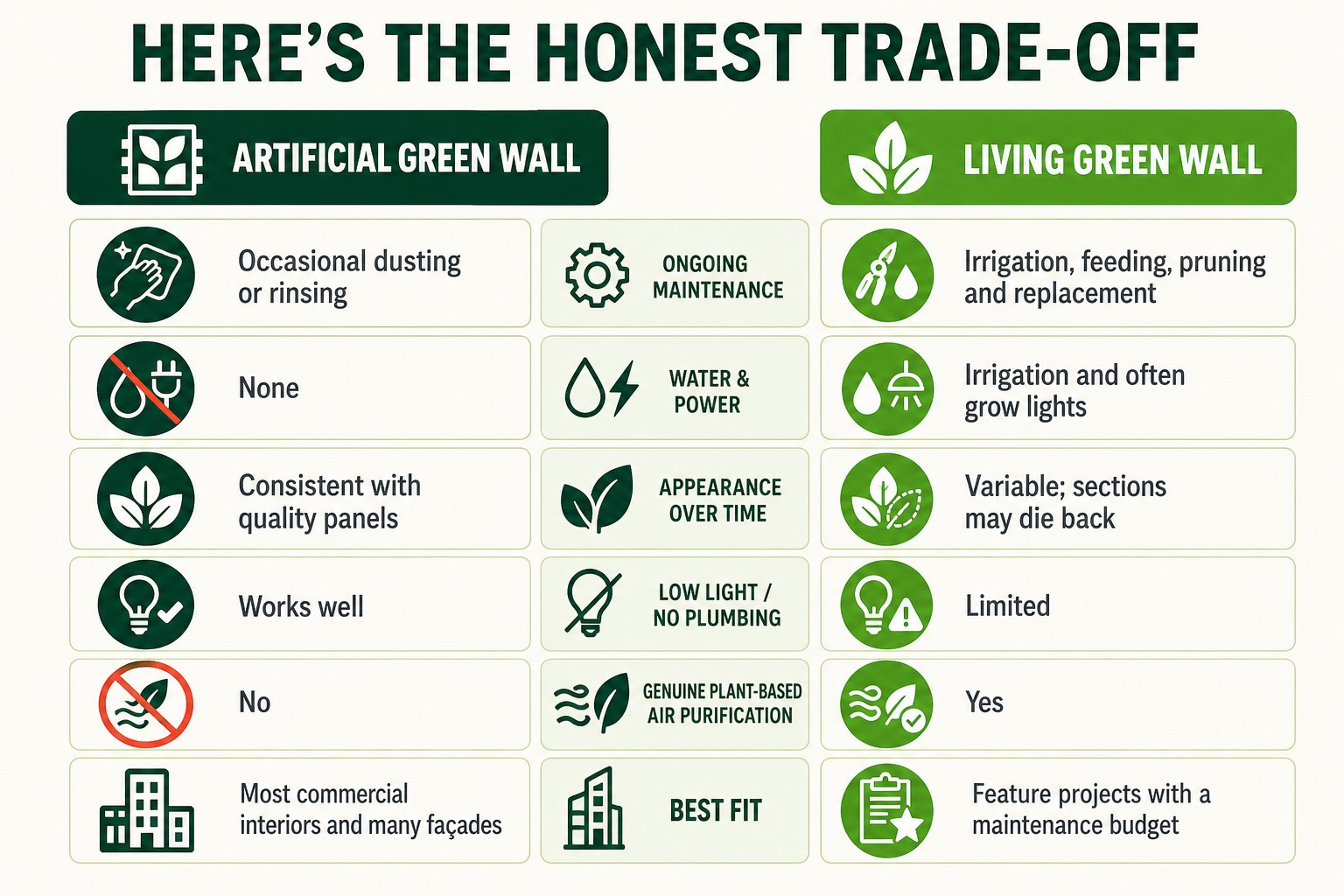
| Factor | Mur végétal artificiel | Living Wall |
|---|---|---|
| Installation | Panels + subframe + standard labor | Waterproofing, plumbing, pumps, plantes artificielles, specialist crew — typically several times higher |
| Ongoing maintenance | Occasional dusting or rinsing | Scheduled horticultural visits, taille, feeding, system servicing |
| Water & power | None | Irrigation supply plus pump and often grow-light electricity |
| Replacements | None in normal service (UV-stabilized panels) | Ongoing plant replacement every year |
| Appearance at year 5 | Unchanged from day one | Dependent on maintenance quality; die-back is common |
| Key risks | UV fade on cheap panels (avoidable by specification) | Leaks, pump failure, pests, maintenance lapses |
| Best fit | Most commercial interiors and many facades | Feature projects with a permanent maintenance budget |
Across a typical five-year horizon, the artificial option’s total cost of ownership is dominated by day-one installation; the living wall’s TCO is dominated by everything after. For procurement teams comparing artificial green wall vs living wall bids, the living option’s year-one number is never the real number.
FAQ
Do artificial green walls purify the air?
No — and any supplier claiming otherwise should be questioned. Artificial walls deliver the visual and spatial benefits of greenery without biological functions. If measured air-quality improvement is a project requirement, that points toward a living system with a maintenance plan.
Can a living wall work without irrigation plumbing?
Only at small scale. Manual watering is viable for a few planters, not for a wall of any commercial size — inconsistent moisture is the fastest route to die-back. Commercial living walls need automated irrigation, which is where much of the cost and risk enters.
Which lasts longer outdoors, artificial or living?
Outdoors, a quality UV-stabilized artificial wall typically outlasts a living one in visual terms: living walls face frost damage, heat stress, wind burn, and seasonal die-off, while rated artificial panels hold their appearance for five to eight years with no biological variables.
Does an artificial wall look fake up close?
Cheap ones do. Une végétation dense, multi-depth panels with mixed leaf shapes and color tones are convincing at normal viewing distances — which is why we always recommend judging a physical sample rather than catalogue photos before specifying.
Which is better for leased or multi-site commercial spaces?
For teams weighing artificial green wall vs living wall across leased or multi-site spaces, artificial wins almost without exception. Panels install without plumbing alterations, remove cleanly at lease end, relocate to the next site, and need no maintenance contracts across a property portfolio.
Judge the Material Before You Run the Final Numbers
The artificial green wall vs living wall decision usually resolves itself once the five-year figures are on the table — but the quality question underneath it can only be settled in hand. Foliage density, la fidélité des couleurs, backing structure, and fire documentation all need physical verification.
All Weather Greens fabrique des panneaux de mur végétal artificiel en Chine pour les importateurs, paysagistes, and project contractors worldwide — UV-stabilized, fire-rated, and built for long service. Demander un devis and benchmark the material against any living-wall quote on your desk.